The Function of Nutrients
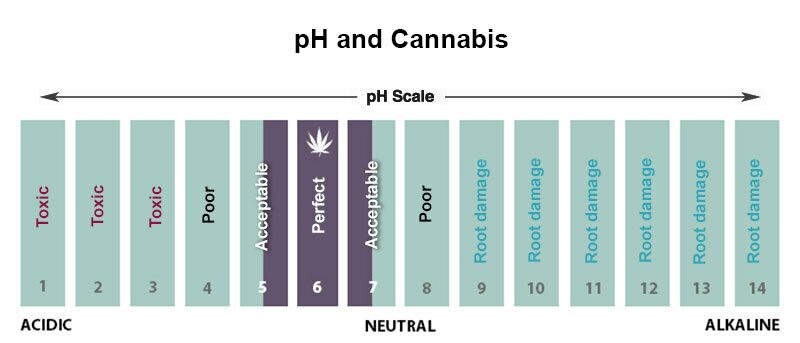
Before attempting to identify any cannabis deficiency it’s important to check that your pH is in the right region. Those growing in soil (or similar mediums) should aim for a pH of around 5.8-6.8. Half way between, at around pH 6.3 is thought to be ideal. Note that many soil (and soil related) grow media should ‘self buffer’ and be naturally at the right pH. But it’s always worth checking. Hydroponic growers will often refer to nutrient manufacturers recommendations, but a pH of around 6 is not uncommon.
It is always wise to be aware of the natural pH of your local water. Remember that your water pH can vary, don’t assume it is always the same. At different times of the year, with different rain fall and treatment levels pH can drift up and down slightly. Understanding the pH of your own water source is a good starting point and something that really is worth monitoring.
Some local water sources can have naturally high levels of some minerals but may be low in others. This can make it tricky to use certain nutrient additives if you already have variable levels in your water supply.
That’s why some professional growers try to take the variables within the natural water supply out of the equation and use fully deionised water. This is water that has been specially filtered to remove any mineral ions present. The result is pure water that is free from any mineral content. Some growers prefer to use fully deionised water as the starting point. But this approach tends to be used by a small minority of serious growers. Most cannabis home growers tend to use tap water and find it generally works well enough.
Mobile / Immobile Nutrients
Macronutrients are those required in high quantities by your cannabis plants. The main macronutrients for cannabis are Nitrogen, Potassium and Phosphorus. These are used in many of the primary biochemical processes during vegetative growth and bloom.
Micronutrients are minerals that are required in trace quantities to ensure that plant cellular biology can function well. Micronutrients include Copper, Silicon, Zinc, Sulphur etc.
Mobile vs immobile nutrients in cannabis deficiencies
Understanding the subtle differences between mobile and immobile nutrients can also help the grower understand cannabis deficiencies better. Mobile nutrients such as Phosphorus can be transferred from one part of the plant to another. If that Phosphorus was stored in an old fan leaf before being transferred to another part pf the plant, you will first spot the deficiency in older growth.
Other minerals, such as Zinc are immobile minerals. Once deposited by the plant, they are difficult to transfer around the plant. This means that you might initially notice deficiencies of immobile minerals in new growth.
- Immobile nutrients show nutrients deficiency & excess on newer leaves
- Mobile Nutrients show deficiency & excess on older leaves
- Semi-Mobile nutrients show deficiency & excess on older or newer leaves
- Where am I seeing the Deficiency older or newer growth?
| Primary | |||
|---|---|---|---|
| Nitrogen | N | Mobile | Formation of amino acids, vitamins and proteins; cell division |
| Phosphorous | P | Mobile | Energy storage and transfer; cell growth; root and seed formation and growth; winter hardiness; water use |
| Potassium | K | Mobile | Carbohydrate metabolism, breakdown and translocation; water efficiency; fruit formation; winter hardiness; disease resistance |
| Secondary | |||
| Calcium | Ca | Immobile | Cell division and formation; nitrogen metabolism; translocation; fruit set |
| Magnesium | Mg | Mobile | Chlorophyll production; phosphorus mobility; iron utilisation; fruit maturation |
| Sulphur | S | Immobile | Amino acids formation; enzyme and vitamin development; seed production; chlorophyll formation |
| Micro Nutrients | |||
| Boron | B | Immobile | Pollen grain germination and tube growth; seed and cell wall formation; maturity promotion; sugar translocation |
| Chlorine | Cl | Mobile | Role not well understood |
| Copper | Cu | Immobile | Metabolic catalyst; functions in photosynthesis and reproduction; increases sugar; intensifies colour; improves flavour |
| Iron | Fe | Immobile | Chlorophyll formation; oxygen carrier; cell division and growth |
| Manganese | Mn | Immobile | Involved in enzyme systems; aids chlorophyll synthesis; P and CA availability |
| Molybdenum | Mo | Mobile | Nitrate reductase formation; converts inorganic phosphates to organic |
| Nickel | Ni | Mobile | Nitrogen metabolism and fixation; disease tolerance |
| Zinc | Zn | Immobile | Hormone and enzyme systems; chlorophyll production; carbohydrate, starch and seed formation |