How To Manifold Cannabis Plants
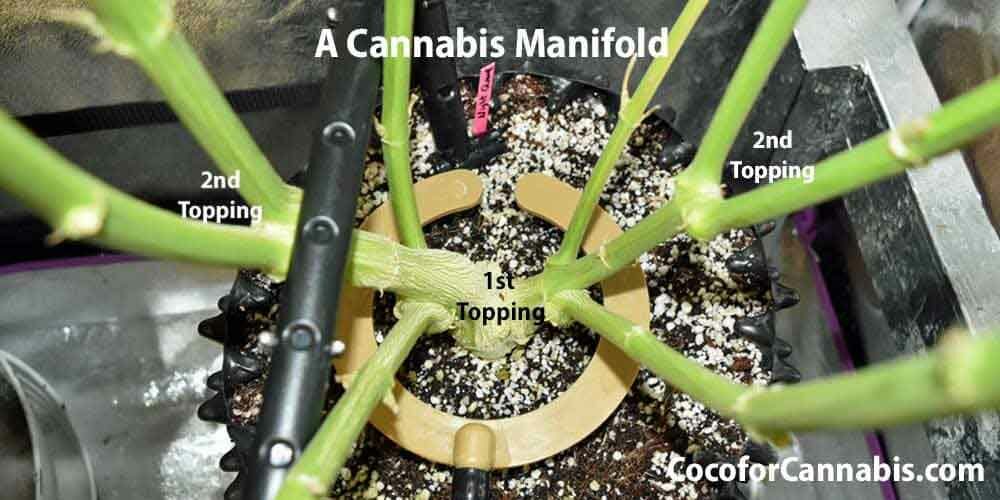
Step 1: Grow the plant to six nodes
The first step in manifold training is to grow the plant out to six nodes. It is important to wait to allow the plant to develop six nodes before topping for the first time. As we explain in our article, “Topping Cannabis Plants: Why, When & How”, if you top earlier than this you risk stunting the plant. It often seems counterproductive to new growers to wait for growth and then cut it all off. However, the growth that is most important during this time is in the root system. Leaving the plant unmolested until it develops six nodes ensures that it has adequate time to develop a good root system. An established root system will prevent shock and help the plant to recover quicker from the topping.
Trim the Tips, but Leave the Leaves
During the early growth of the plant it is critically important to keep every single leaf that you can. The leaves are powering the growth of the plant and removing them will slow the plant’s growth considerably. That said, you can and should remove the growth tips that you will not keep. In both mainline and manifold training, we only keep the branches from the third node on the main stalk. That means that we need to trim off the branches from the first and second nodes. You can trim these as soon as you can safely cut them away without injuring the adjacent fan leaf. Remember, trim the tips but leave the leaves!
Topping and Transplanting
In early life, our job as growers is to encourage healthy growth and good root development. As with all plants, I recommend starting in small containers and potting up. Be sure to read our article, “Transplanting Cannabis Plants: Why, When & How”.
Plants are often ready for final containers around the same time that they are ready to be topped for the first time. When I use half-gallon second containers, I often transplant to final containers before topping. In larger second containers, you should plan to do the first topping in the second container and then transplant to final containers. Both topping and transplanting can be stressful events for plants. Therefore, you should always separate them by a day or two and verify the plant has recovered from one before doing the other.
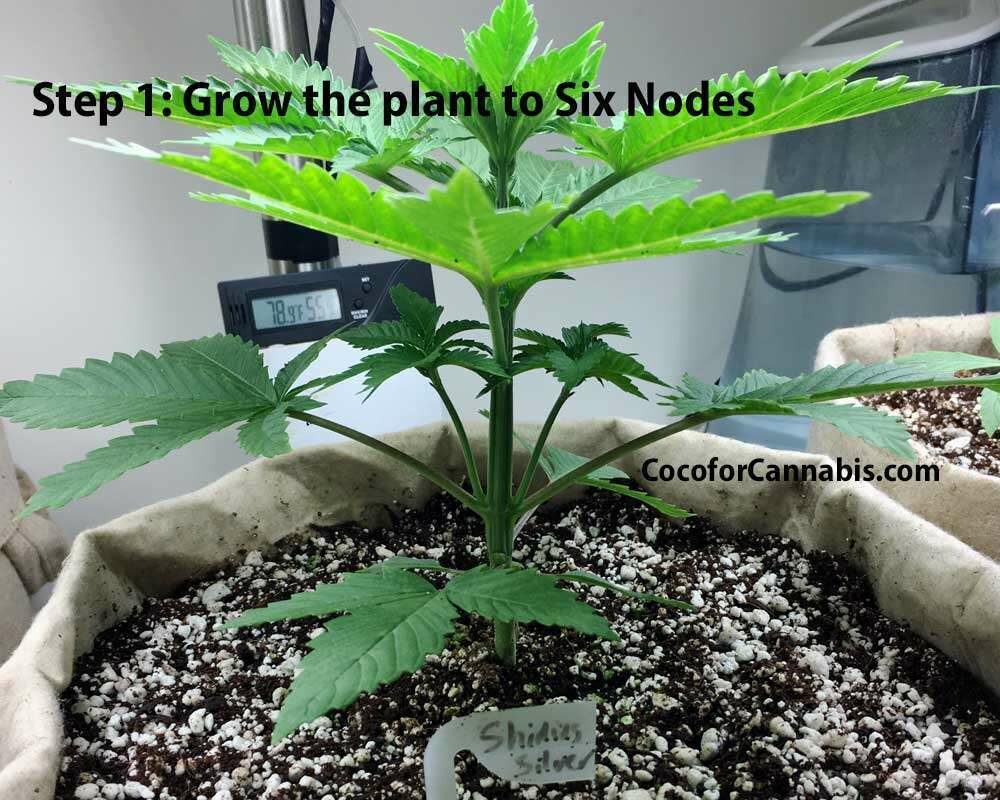
Step 2: Top the plant to the third node
This is a pretty simple step, but it can be hard to bring yourself to do it. We spend three weeks or more nurturing these little plants and then we are supposed to chop them in half. If you struggle with this step, then you are like virtually every other cannabis grower who has tried it. However, I assure you – it will work out for the best in the end.
We top manifolds to the third node. This means that we remove the fourth node and everything above it. The branches growing from the third node become the two new “tops”. They are the main branches, and each will be topped again in time. The lower branches from the first and second node were removed during step one. Therefore, following this first topping there are exactly two branches on the plant.
Leave a stump
When we top the main stalk to make a manifold, it is important to leave a stump. Avoid cutting close to the third node. Instead make the cut just below the fourth node. This leaves a large section of “stump”. It may look ugly but helps to prevent stem splitting. As the plant grows, it will eventually envelope this “stump”.
Use sharp snips like the Fiskars snips that I use. Apologize to the plant if you feel that you are betraying her, and then it is just a quick snip and it’s done. If you have space, you can take the tops that are removed during this topping and clone them.

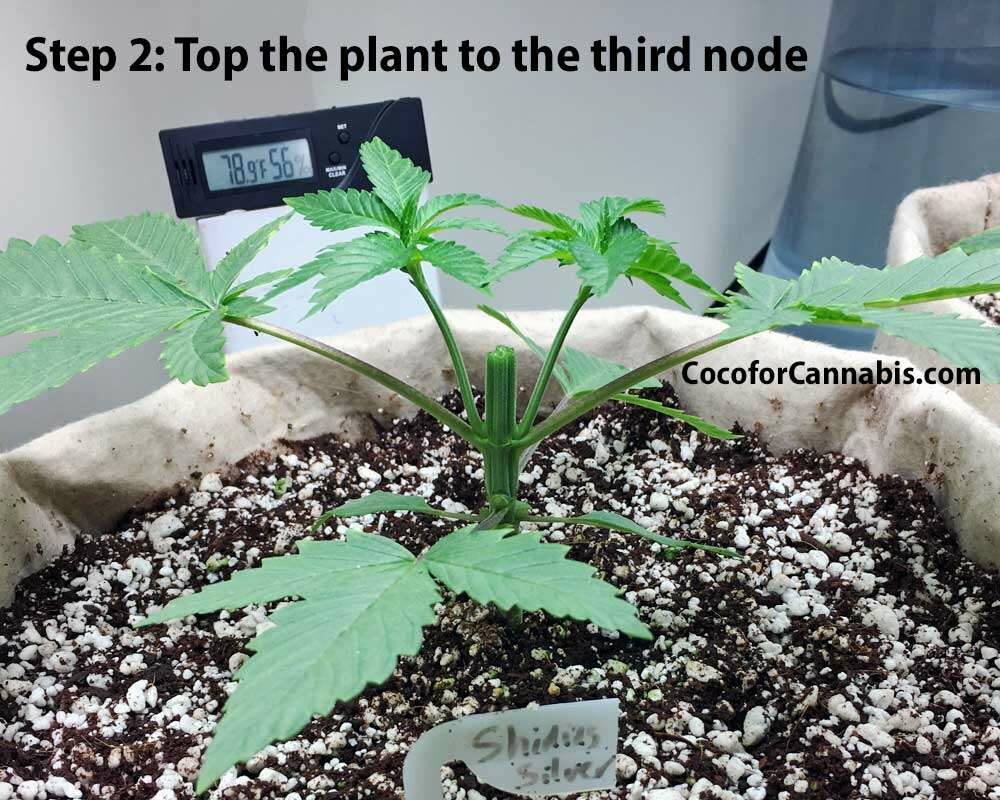
Step 3: Grow both branches to the fourth node
Following the first topping I allow my plants to grow unimpeded until each main branch is working on its fourth node. In coco, this usually takes 5-6 days. It will take somewhat longer in soil.
There are manifold training guides that recommend aggressive training during this stage. I disagree with this approach and argue that it is counterproductive to our ultimate goals. You can gently bend the branches away from each other if they need space, but aggressive bending and supercropping should wait until these branches have reached past their third node.
Remove the growth tips on the second node
For manifold training we will preserve the growth tips from the first and the third node on each of the two branches. However, the growth tips on the second node need to be removed. You can trim these as soon as you can cut it away without injuring the adjacent fan leaf. You want to keep all the leaves that you can to power the growth of your plant.
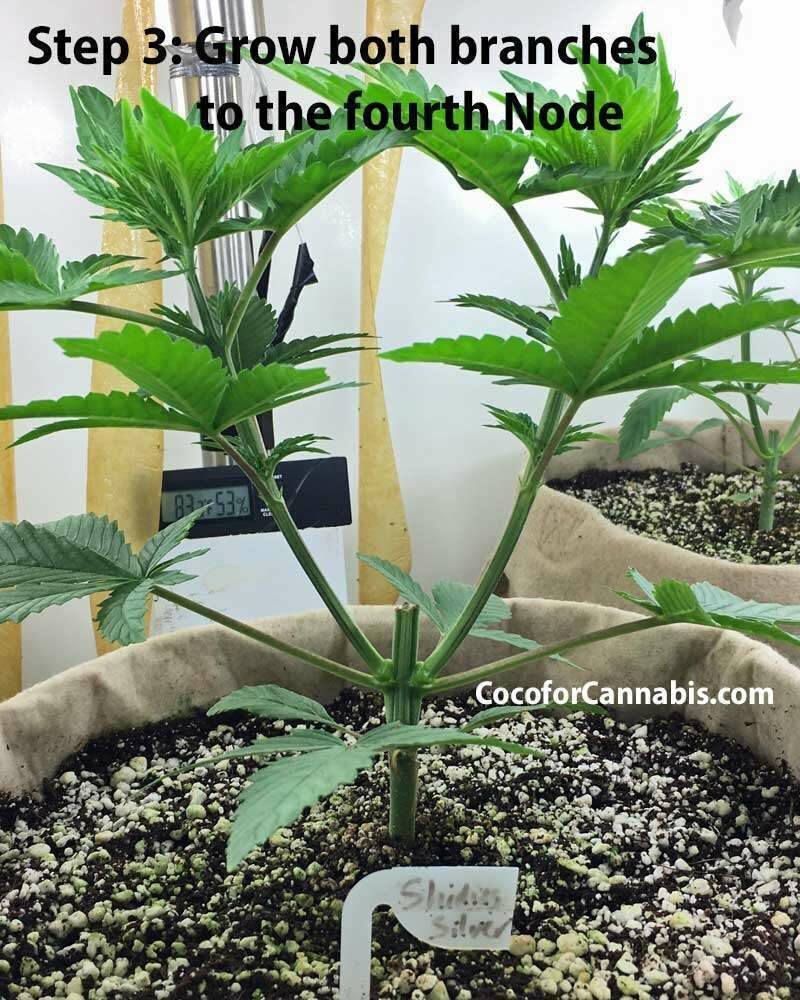
Step 4: Top both branches to their third node
When each main branch has grown past the third node it is time to top them again. Unlike, the first topping, it is not important to let the plant grow much past the third node. Initially that is important to allow the plant to establish a root system. At this point we can top the plants as soon as they are ready.
You can do the second topping as soon as you can safely cut the main stalk without injuring the tips on the third node. It is helpful to wait for the fourth node to start to push away from the third to have room to make the cut. However, you can also gently pull the leaves back to expose and cut the stem earlier. Just make certain that you do not injure or remove the two growth tips on the third node.
Following this step, you should have eight growth tips remaining on the plant. There are two main branches. On each main branch there are two growth tips coming from the first node and two growth tips on the third node. Because the remaining branches emerge from different nodes on the plant we now need to train them so that they will develop equally.
Step 5: Train the main branches
After the second topping it is time to begin really training the two main branches. Because we remove very little growth from the plant during the second topping, we can begin training without waiting for the plant to “recover”. I often top and train during the same session.
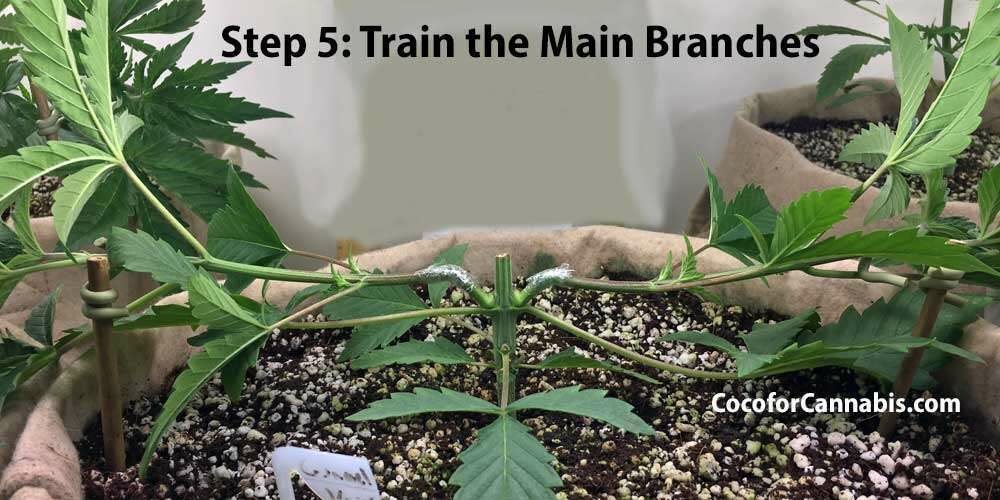
With manifolds, our first training priority is to ensure that all eight branches develop equally. When you use mainline training, the branches are equal because they all emerge from the same height on the plant. However, with manifold training we keep branches on both the first and the third nodes during the second topping. Without training the growth tips on the third node will become dominant and suppress the growth of the branches on the first node.
The natural tendency of cannabis is for the terminal growth tips to be dominant. We can reduce this tendency by lowering the terminal growth tips through training. Training eight equal main branches on a manifold requires significantly lowering the two main branches. The goal is to have the first node and the third node at the same relative height above the ground.
There are two options for this training. You can use low stress training which is gently bending the main branches down and securing them with soft ties. Alternatively, you can supercrop the two main branches.
Supercrop Manifolds for Even Growth
I recommend supercropping to create the best symmetry among the eight colas. Super- cropping is a technique based on pinching the stem to break the inner core. Softening the stem in this fashion allow us to bend and fold branches without injuring them. It allows us to lower the main branches more than low stress training. Furthermore, it produces knuckles at the point of supercropping which become points of structural support for the manifolded plant. I discuss the specific practice of supercropping these branches in our tutorial, “When & How to Supercrop Cannabis Plants”.
Promote the growth of the branches on the first node
The branches on the first node will be larger than the tips at the third node when you do the second topping. However, the goal is to continue to promote the growth of those first node branches. We need to give them every advantage early or the third node branches will dominate and suppress their growth. One way that we do this is by bringing the third node tips down to the level of the first nodes. We also need to make sure that the first node branches get good light.
There is one leaf that you can cut off
At this point in the training, the plant should still have all its leaves. However, after supercropping the main branches there is one leaf that is in your best interest to prune. On almost every cannabis manifold, when the main branches are supercropped, the inside leaf from the second node will cover the two growth tips from the first node. It is really a shame that we have to prune this leaf, because it is perfectly positioned to receive light. However, its shade will slow the growth of the branches on the first node. At this stage of the process, promoting the first node branches is our first priority
Manifold Training for Clones
Mainline and manifold training for clones is more difficult because clones grow without symmetry. Early in life cannabis plants produce symmetrical nodes with two branches that emerge from every node at the same place. However, as the plants mature, the nodes lose their symmetry and the branches emerge at different points on the stalk. Since cannabis clones are usually taken from mature plants, they have asymmetrical nodes. The lack of symmetry makes it a challenge to top the plants and produce two equal branches.
When working with clones it is no longer possible to neatly count nodes. Instead, you choose branches to keep based on their position and in some cases based on their potential.

For the initial topping you should choose a pair of branches that emerge from close to the same spot on the stalk. If there is little difference, then choose the most vigorous adjacent two branches. Cut the main stalk above the set of branches that you select.
After the initial topping one little branch will be higher than the other. It is critical to lower the height of the higher branch and shift dominance towards the branch that emerges lower on the main stalk. I hold the upper branch down until the lower branch has gained a slight advantage and appears thicker than the upper. This may take 2-4 days.
When the two main branches are growing out you need to select 4 growth tips on each side to keep. Because of the asymmetrical growth of clones, each plant will be a little different. The rule here is just to choose branches that are vigorous and pointed in the right direction. Remove the tips you will not keep and top the branch above the fourth tip that you will keep.
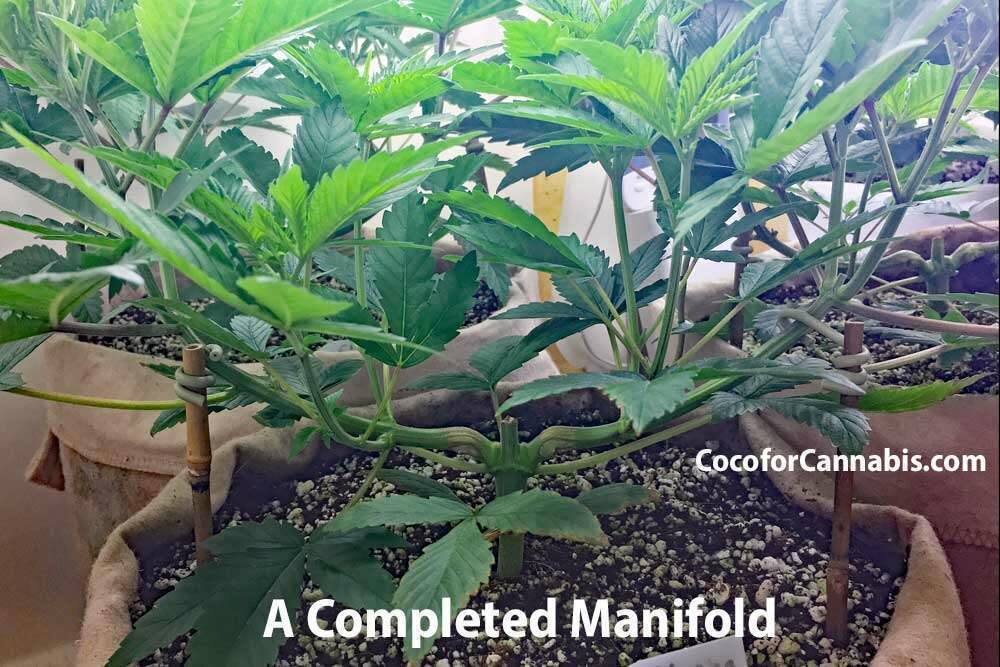
In most other ways, manifold training for clones is just like manifold training for seedlings. For both types of plants, once the basic structure is complete we shift our attention to pruning and training to spread the plant out and promote an even canopy.
The Next Steps
Once you have eight main branches, the manifold structure is complete. The plants are usually about four to six weeks old and entering the late vegetation stage. This is an exciting time for cannabis manifolds because the growth will explode over the next several weeks.